Skip to content
Donald Trump Contradicts Adviser Jared Kushner on Iran: Where Talks Stand
[Latest\\
\\
Byron Donalds’ Chances of Losing to David Jolly in Florida Governor Race](https://www.newsweek.com/byron-donalds-chances-losing-david-jolly-florida-governor-race-12333570)
- U.S.
[News](https://www.newsweek.com/news) [Politics](https://www.newsweek.com/politics) [Tech](https://www.newsweek.com/technology) [Fact Check](https://www.newsweek.com/fact-check) [Sports](https://www.newsweek.com/sports)
- Global
[Iran War](https://www.newsweek.com/topic/iran-war) [Russia-Ukraine](https://www.newsweek.com/topic/russia) [Middle East](https://www.newsweek.com/topic/middle-east) [China And Asia](https://www.newsweek.com/topic/china) [Live Blog](https://www.newsweek.com/live-blog) [Better Planet](https://www.newsweek.com/better-planet) [All World News](https://www.newsweek.com/world)
- Lifestyle
[Family & Parenting](https://www.newsweek.com/topic/parenting) [Entertainment](https://www.newsweek.com/entertainment) [Travel](https://www.newsweek.com/travel) [Pets](https://www.newsweek.com/pets) [Automotive](https://www.newsweek.com/autos) [Relationships](https://www.newsweek.com/relationships) [Science](https://www.newsweek.com/tech-science) [Health](https://www.newsweek.com/health) [Personal Finance](https://www.newsweek.com/personal-finance) [Better Workplaces](https://www.newsweek.com/better-workplaces) [Readers Choice](https://www.newsweek.com/readerschoice)
- Opinion
[My Turn](https://www.newsweek.com/my-turn) [All Opinion](https://www.newsweek.com/opinion)
- Rankings
[Health](https://rankings.newsweek.com/category/health) [Finance](https://rankings.newsweek.com/category/finance) [Products](https://rankings.newsweek.com/category/products-services) [Education](https://rankings.newsweek.com/category/education) [Workplaces](https://rankings.newsweek.com/category/work) [Corporate Responsibility](https://rankings.newsweek.com/category/corporate-responsibility) [All Rankings](https://rankings.newsweek.com/)
- Social
[Facebook](https://www.facebook.com/Newsweek) [Instagram](https://www.instagram.com/newsweek) [Threads](https://www.threads.com/@newsweek) [YouTube](https://www.youtube.com/newsweek) [Reddit](https://www.reddit.com/user/newsweek/) [TikTok](https://www.tiktok.com/@newsweek) [Twitter/X](https://x.com/newsweek)
- Extra
[Newsletters](https://www.newsweek.com/preference-center) [Newsmakers](https://www.newsweek.com/newsmakers) [Unconventional](https://www.newsweek.com/unconventional) [Events](https://events.newsweek.com/) [Essays](https://www.newsweek.com/essays) [Podcasts](https://www.newsweek.com/podcasts) [Vantage](https://www.newsweek.com/topic/vantage) [Insights](https://www.newsweek.com/insights) [Magazine](https://www.newsweek.com/archive) [CEO Circle](https://www.newsweek.com/ceo-circle) [Announcements](https://www.newsweek.com/announcements) [Leadership](https://www.newsweek.com/leadership) [Dev Pragad](https://www.newsweek.com/dev-pragad)
President Donald Trump said that the United States is not in talks with Iran after the two nations' memorandum of understanding expired with little signs of progress in ending the six-month war. "There are no talks or conversations going on, or scheduled, with the Islamic Republic of Iran," Trump wrote Tuesday on Truth Social. "The Naval Blockade remains in full force and effect. The Hormuz Strait is open and operating. All water mines have been removed or detonated." The comment appeared to contradict the president's adviser and son-in-law, Jared Kushner, who told Fox News on Monday that the U.S. and Iran "continue to have communications. He said Trump was waiting to "make the right deal when the right deal is ready, but we are having very positive and active conversations" with Iran. Trump said the same day that Iranian officials "want to make a deal," though "they're not going to make the kind of a deal that I feel is necessary." Newsweek has since learned from a source with knowledge that discussions described as positive have taken place, but President Trump has decided to wait and asked his team to not engage until Iran is ready to make a deal. Mixed messaging has long dominated the fragile diplomacy surrounding efforts to end the conflict launched by the U.S. and Israeli against Iran on February 28, with Washington often claiming breakthroughs and Tehran frequently downplaying or even denying active negotiations. Sina Azodi, assistant professor at George Washington University's Elliott School of International Affairs, told Newsweek that the apparent inconsistency served as evidence "that the U.S. currently does not have a strategy, and this is why the messaging is not coherent." Are the US and Iran in Talks? The U.S. and Iran were engaged in discussions regarding the latter's nuclear program when the war was launched, putting diplomacy on hold. The first confirmation of new communication came with a ceasefire reached in April, followed by intensified interactions that ultimately produced a memorandum of understanding signed by Trump and Iranian President Masoud Pezeshkian on June 17. The agreed-to framework was broad but ultimately aimed at pausing hostilities for 60 days until a more comprehensive deal could be reached. Instead, both sides quarreled over the terms of their understanding almost immediately, with new clashes erupting after three tankers came under attack while transiting what Iranian officials described to be an unauthorized route. While the two sides have yet to return to the scale of conflict in the earlier stages of the war, Iran has sought to maintain dominance over the Strait of Hormuz while the U.S. has returned to a policy of blockading the passage of vessels destined to and departing from Iranian ports as a form of economic pressure. Diplomacy did resurface, however, in the form of a bilateral track between Iran and Oman, a Gulf Cooperation Council (GCC) member whose Musandam Peninsula exclave bordering the United Arab Emirates' territory lies directly across the Strait of Hormuz from Iran's southern shores. Muscat, which has traditionally enjoyed close ties with both Washington and Tehran, reportedly proposed a deal that would see the establishment of a voluntary toll system, mirroring mechanisms in place in the Strait of Malacca and Singapore Strait. Trump continued to claim that the U.S. was involved in the talks, though Iran denied this, eliciting frustration from the U.S. leader. On Monday, Trump told Fox News that he would order strikes again Oman "if it gets in the way" of the U.S. controlling the Strait of Hormuz while also alleging a direct backchannel to Iran's influential Islamic Revolutionary Guard Corps (IRGC) Trump's latest comments indicating that no talks were taking place, however, appear to align with Iran's own messaging. IRGC spokesperson Brigadier General Hossein Mohebbi told Iran's semi-official Tasnim News Agency on Monday that "there is no ongoing dialogue between IRGC officials and the Americans, and this lie by Trump is merely a fantasy that he has suffered from due to the illusions and nightmares caused by defeat and despair in the war." Azodi also felt that Trump's remarks appeared "not compatible with the reality on the ground." "It is likely that Jared Kushner is in contact with Omanis who are negotiating with Iranians to open the Strait," Azodi said. "But the fact remains that none of Trump’s war objectives have been achieved and the conflict has made the situation even worse by the closing of this important global economic chokehold." Both Sides Believe They're Winning A key source of dissonance in the effort to bring a diplomatic close to the conflict is that Washington and Tehran fundamentally believe they have the upper hand. Iranian analysts have told Newsweek that perceived successes in demonstrating the Islamic Republic's resilience and capabilities have only emboldened the government's push to dictate terms and push for escalation if diplomacy fails. Some, however, caution that Tehran could overplay its hand should its advantages deteriorate. Trump, too, has repeatedly claimed victory throughout the war. But his proclamations have been tested by the ongoing disruption of Strait of Hormuz traffic, inflated energy prices and plummeting U.S. support for the campaign, along with reports indicating that Iran has regrouped its military capabilities as U.S. munitions stockpiles dwindle. Perhaps serving as an even greater complication for renewed diplomatic efforts is both sides appearing to hold little faith in each other's commitments. "Ultimately, the lack of trust between Iranians and the Americans is even at a worse stage because Iranians don’t believe that the U.S. is genuine about a deal, some even suggesting that this is a prelude to another round of conflict," Azodi said. "This is a serious issue since they are operating under this assumption." Contact Newsweek editors on this story: Gabe Whisnant and Dave Siminoff.

By [Tom O'Connor](https://www.newsweek.com/authors/tom-oconnor)
Deputy Editor, National Security and Foreign Policy
23
Share
[Newsweek is a Trust Project member](https://www.newsweek.com/editorial-guidelines)
See more of our trusted coverage when you search.Prefer Newsweek on Googleto see more of our trusted coverage when you search.
* * *
President Donald Trump said that the United States is not in talks with Iran after the two nations' memorandum of understanding expired with little signs of progress in ending the six-month war.
"There are no talks or conversations going on, or scheduled, with the Islamic Republic of Iran," Trump wrote Tuesday on Truth Social. "The Naval Blockade remains in full force and effect. The Hormuz Strait is open and operating. All water mines have been removed or detonated."
The comment appeared to contradict the president's adviser and son-in-law, Jared Kushner, who told Fox News on Monday that the U.S. and Iran "continue to have communications. He said Trump was waiting to "make the right deal when the right deal is ready, but we are having very positive and active conversations" with Iran.
#### Read More on News
Trump said the same day that Iranian officials "want to make a deal," though "they're not going to make the kind of a deal that I feel is necessary."
_Newsweek_ has since learned from a source with knowledge that discussions described as positive have taken place, but President Trump has decided to wait and asked his team to not engage until Iran is ready to make a deal.
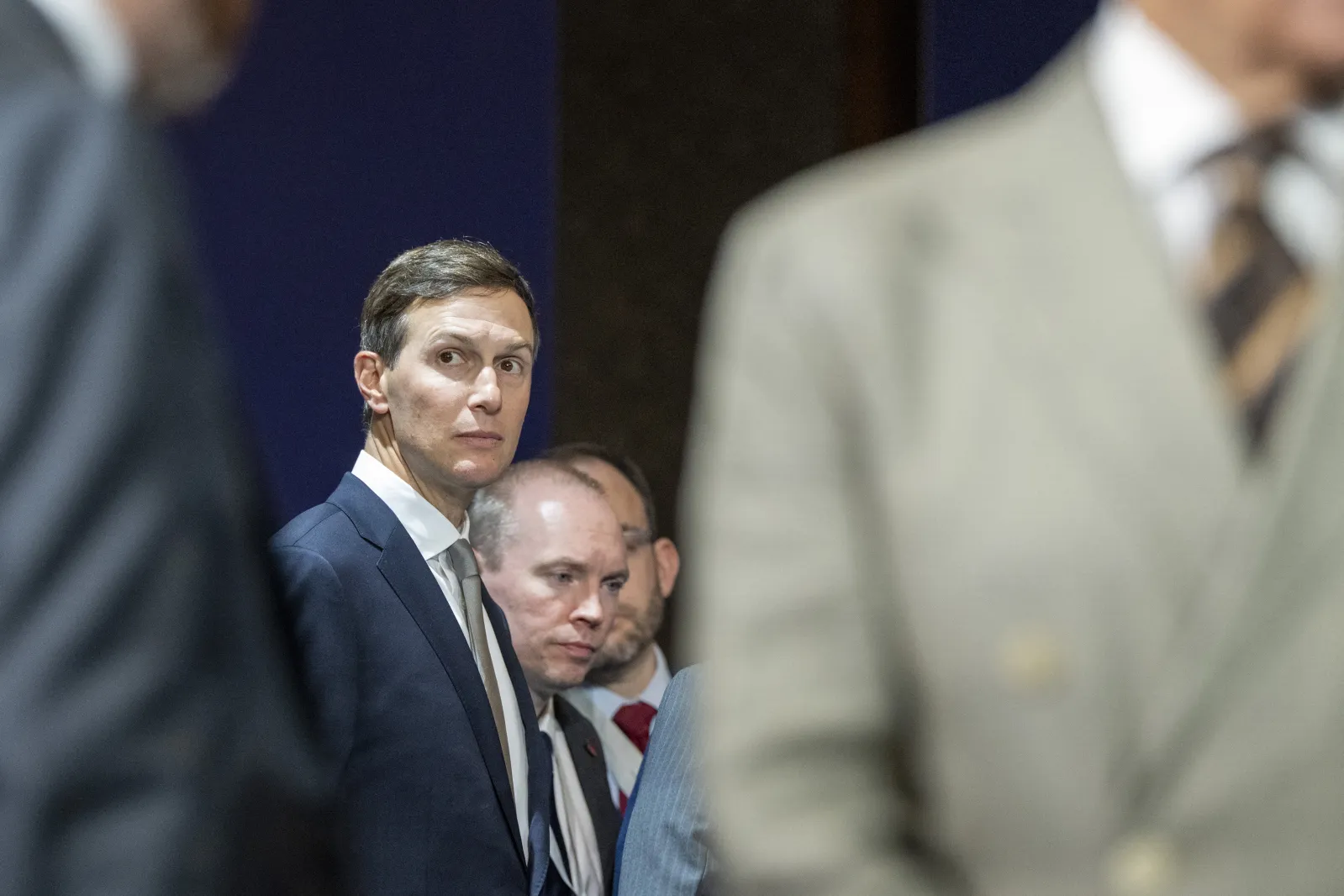
U.S. President Donald Trump's adviser and son-in-law, Jared Kushner, reacts ahead of a meeting between the United States, Iran, Pakistan and Qatar nea...Read More \| Urs Flueeler/Pool/AFP/Getty Images
Mixed messaging has long dominated the fragile diplomacy surrounding efforts to end the conflict launched by the U.S. and Israeli against Iran on February 28, with Washington often claiming breakthroughs and Tehran frequently downplaying or even denying active negotiations.
Sina Azodi, assistant professor at George Washington University's Elliott School of International Affairs, told _Newsweek_ that the apparent inconsistency served as evidence "that the U.S. currently does not have a strategy, and this is why the messaging is not coherent."
[Related Story\\
\\
\\
\\
What the Trump-Erdogan Call Reveals About the New Middle East](https://www.newsweek.com/trump-erdogan-middle-east-nato-defense-pact-12338211)
## Are the US and Iran in Talks?
The U.S. and Iran were engaged in discussions regarding the latter's nuclear program when the war was launched, putting diplomacy on hold. The first confirmation of new communication came with a ceasefire reached in April, followed by intensified interactions that ultimately produced a memorandum of understanding signed by Trump and Iranian President Masoud Pezeshkian on June 17.
The agreed-to framework was broad but ultimately aimed at pausing hostilities for 60 days until a more comprehensive deal could be reached. Instead, both sides quarreled over the terms of their understanding almost immediately, with new clashes erupting after three tankers came under attack while transiting what Iranian officials described to be an unauthorized route.
While the two sides have yet to return to the scale of conflict in the earlier stages of the war, Iran has sought to maintain dominance over the Strait of Hormuz while the U.S. has returned to a policy of blockading the passage of vessels destined to and departing from Iranian ports as a form of economic pressure.
Diplomacy did resurface, however, in the form of a bilateral track between Iran and Oman, a Gulf Cooperation Council (GCC) member whose Musandam Peninsula exclave bordering the United Arab Emirates' territory lies directly across the Strait of Hormuz from Iran's southern shores.
Muscat, which has traditionally enjoyed close ties with both Washington and Tehran, [reportedly proposed](https://www.newsweek.com/iran-war-gives-switzerland-of-middle-east-key-say-in-fate-of-hormuz-12139975) a deal that would see the establishment of a voluntary toll system, mirroring mechanisms in place in the Strait of Malacca and Singapore Strait.
Trump continued to claim that the U.S. was involved in the talks, though Iran denied this, eliciting frustration from the U.S. leader. On Monday, Trump told Fox News that he would order strikes again Oman "if it gets in the way" of the U.S. controlling the Strait of Hormuz while also alleging a direct backchannel to Iran's influential Islamic Revolutionary Guard Corps (IRGC)
Trump's latest comments indicating that no talks were taking place, however, appear to align with Iran's own messaging.
IRGC spokesperson Brigadier General Hossein Mohebbi told Iran's semi-official Tasnim News Agency on Monday that "there is no ongoing dialogue between IRGC officials and the Americans, and this lie by Trump is merely a fantasy that he has suffered from due to the illusions and nightmares caused by defeat and despair in the war."
Azodi also felt that Trump's remarks appeared "not compatible with the reality on the ground."
"It is likely that Jared Kushner is in contact with Omanis who are negotiating with Iranians to open the Strait," Azodi said. "But the fact remains that none of Trump’s war objectives have been achieved and the conflict has made the situation even worse by the closing of this important global economic chokehold."
## Both Sides Believe They're Winning
A key source of dissonance in the effort to bring a diplomatic close to the conflict is that Washington and Tehran fundamentally believe they have the upper hand.
Iranian analysts [have told _Newsweek_](https://www.newsweek.com/what-total-iranian-victory-over-trump-looks-like-five-war-goals-explained-12319445) that perceived successes in demonstrating the Islamic Republic's resilience and capabilities have only emboldened the government's push to dictate terms and push for escalation if diplomacy fails. Some, however, caution that Tehran could [overplay its hand](https://www.newsweek.com/irans-victory-dilemma-explained-12103563) should its advantages deteriorate.
Trump, too, has repeatedly claimed victory throughout the war. But his proclamations have been tested by the ongoing disruption of Strait of Hormuz traffic, inflated energy prices and plummeting U.S. support for the campaign, along with reports indicating that Iran has regrouped its military capabilities [as U.S. munitions stockpiles dwindle](https://www.newsweek.com/us-running-low-ammo-not-trump-top-iran-war-problem-12257621).
Perhaps serving as an even greater complication for renewed diplomatic efforts is both sides appearing to hold little faith in each other's commitments.
"Ultimately, the lack of trust between Iranians and the Americans is even at a worse stage because Iranians don’t believe that the U.S. is genuine about a deal, some even suggesting that this is a prelude to another round of conflict," Azodi said. "This is a serious issue since they are operating under this assumption."
_Contact Newsweek editors on this story:_ [_Gabe Whisnant_](mailto:[email protected]) _and_ [_Dave Siminoff_](mailto:[email protected]) _._
View 23Comments
[Request Reprint & Licensing](https://www.newsweek.com/contact)
Submit Correction
[View Editorial & AI Guidelines](https://www.newsweek.com/editorial-guidelines)